April 2026
Bifidobacterium breve PS1 WGS analysis
Whole-genome reconstruction of Bifidobacterium breve PS1 highlighting substrate predictions and probiotic potential.
- Whole genome sequencing
- Microbiome genomics
- Probiotics
Overview
This project reconstructs and functionally profiles the genome of Bifidobacterium breve PS1, a breastmilk-derived strain. The work combines long-read genome assembly, annotation, comparative genomics, and carbohydrate utilization analysis.
The CAZyme and GlycoBif analyses reveal how the strain is equipped to process host-associated glycans and prebiotic substrates.
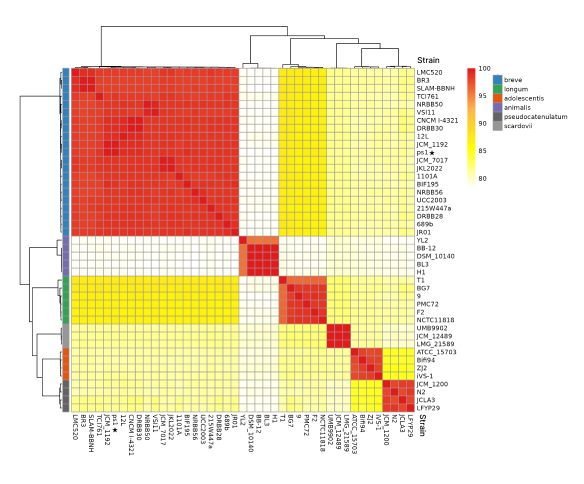
Figure 1: Clustered heatmap of Average Nucleotide Identity (ANI) across all 44 Bifidobacterium genomes. B. breve PS1 is starred.
CAZyme and GlycoBif Findings
CAZyme profiling showed that B. breve PS1 carries a carbohydrate-active enzyme dominated by glycoside hydrolases (61 genes), followed by glycosyl transferases (33 genes) and carbohydrate esterases (5 genes).
GlycoBif analysis predicted that B. breve PS1 can utilize key infant-associated substrates including lacto-N-tetraose (LNT), lacto-N-neotetraose (LNnT), lacto-N-biose (LNB), and N-acetylneuraminic acid (Neu5Ac). The same analysis also supported utilization of galactooligosaccharides (GOS) and short-chain fructooligosaccharides (scFOS).
These results suggest that B. breve PS1 is well adapted to early-life gut ecology, can participate in HMO-linked cross-feeding networks, and may remain metabolically competitive during the transition from breastfeeding to more complex dietary substrates.
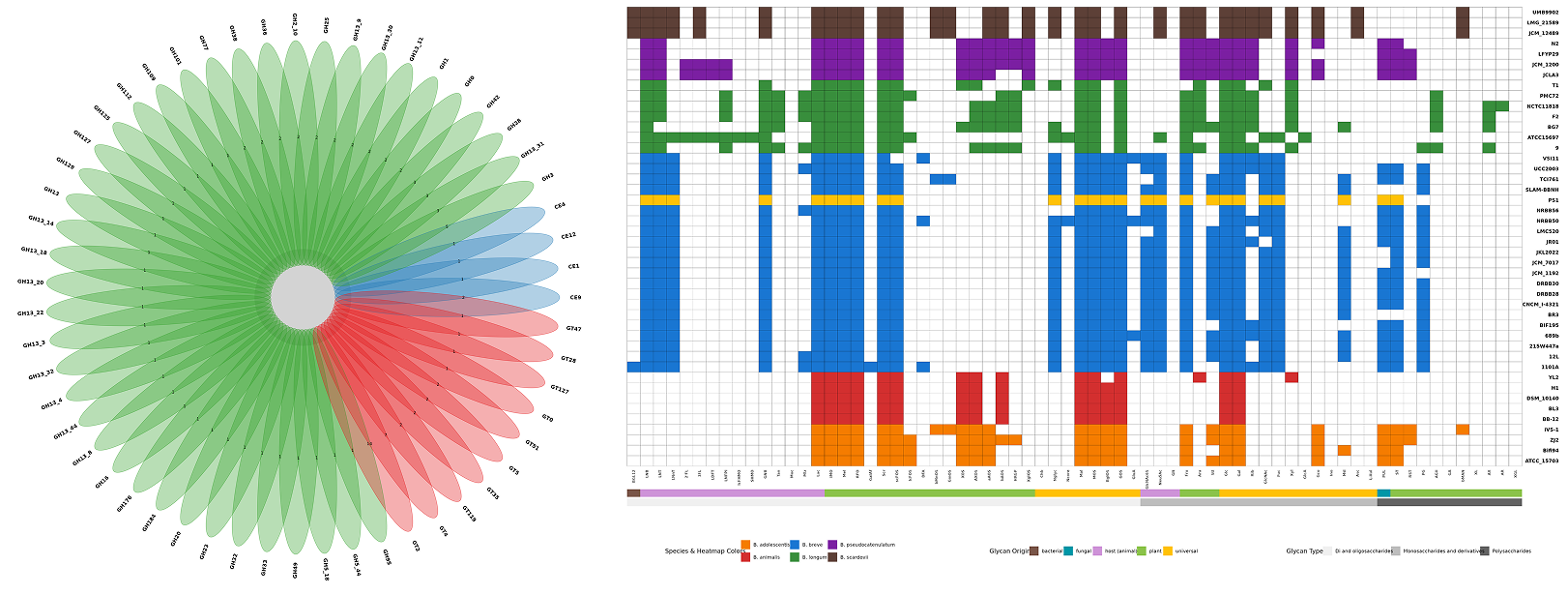
Figure 2: (Left) Distribution of CAZymes in the genome of B. breve PS1. (Right) Predicted substrate utilization based on GlycoBif analysis across representative Bifidobacterium strains (PS1: yellow)
Immunomodulatory Potential
The immunostimulatory potential of B. breve PS1 was characterized through in silico CpG motif profiling and island mapping. Both type 1 (palindromic) and type 2 hexamers were quantified and yielding a combined total of 20,199 CpG motifs. This density of immunostimulatory motifs supports the capacity of B. breve PS1 to engage innate immune pathways.
Beyond CpG-based immune engagement, the genome encodes Serpin, a serine protease inhibitor involved in modulating host inflammatory proteases. The strain also carries complete gene clusters for exopolysaccharide (EPS) production, including a full cps4 locus encoding the priming glycosyltransferase Cps4H, O-antigen polymerase, and associated EpsF/EpsH glycosyltransferases. EPS production is associated with immunomodulatory interactions at the mucosal surface and enhanced colonization persistence.
Links
- GenBank accession: CP162120